
Introduction
Accurate medication delivery is an important part of patient care, particularly in hospitals and critical care environments. Certain treatments require medicines or fluids to be administered in controlled quantities and at carefully selected rates. In such situations, a syringe pump can help healthcare professionals manage medication delivery according to the prescribed settings.
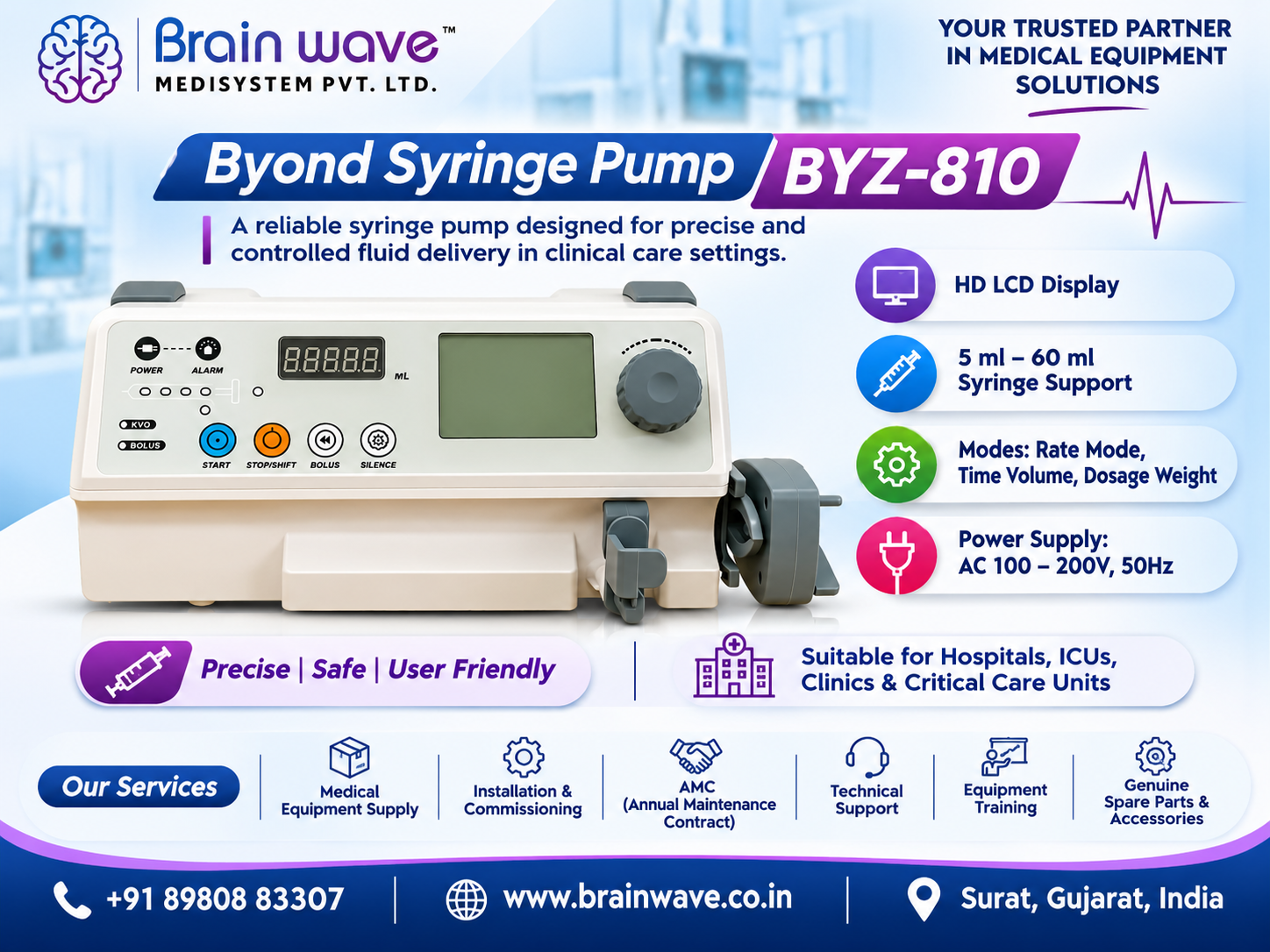
The Byond Syringe Pump BYZ-810 is designed to deliver fluids from a syringe at a controlled rate. It offers three working modes: Rate Mode, Time-Volume Mode and Dosage-Weight Mode. The device also includes features such as a voice alarm system, audible and visual alerts, bolus and purge functions, and Keep Vein Open (KVO) functionality.
The BYZ-810 supports compatible syringe sizes of 5 ml, 10 ml, 20 ml, 30 ml and 50/60 ml, according to its product listing. Its LCD screen displays working information, while its alarm system alerts the operator to conditions such as occlusion, low battery and incorrect syringe installation.
Brainwave Medisystem Pvt. Ltd., based in Surat, Gujarat, India, supplies medical equipment to hospitals, clinics and healthcare facilities. Healthcare professionals and procurement teams looking for the Byond Syringe Pump BYZ-810 can contact Brainwave Medisystem for product enquiries and related support.
What Is a Syringe Pump?
A syringe pump is a medical device used to deliver a controlled quantity of fluid from a syringe over a selected period or at a specified rate. It is commonly used when medication delivery needs to be managed through controlled infusion rather than manual administration.
The syringe is fitted into the pump, and the device mechanism moves the syringe plunger according to the selected settings. This allows healthcare professionals to manage the delivery rate based on the prescribed treatment requirements.
Syringe pumps are used in different clinical environments, including intensive care units, operation theatres, neonatal care units and other hospital departments where controlled medication delivery is required.
The correct device settings, syringe compatibility and clinical supervision are essential. A syringe pump does not replace the judgement of qualified healthcare professionals. It is a tool used as part of a treatment process.
Introduction to the Byond Syringe Pump BYZ-810
The Byond Syringe Pump BYZ-810 is a single-channel syringe infusion device designed for controlled fluid delivery. It includes multiple operating modes and alarm functions to support its use in healthcare environments.
The product listing highlights three working modes:
- Rate Mode
- Time-Volume Mode
- Dosage-Weight Mode
It also includes a Human Voice Alarm system, an LCD display, automatic calibration, KVO and bolus functions. The device is listed as compatible with different syringe capacities and offers AC power, an internal rechargeable battery and a DC 12V car charging option.
These features make the BYZ-810 a product that hospitals and healthcare facilities can evaluate when selecting syringe infusion equipment.
Key Features of the Byond Syringe Pump BYZ-810
1. Three Working Modes
The BYZ-810 offers three operating modes to support different infusion-setting requirements.
Rate Mode: This mode allows the operator to set the intended infusion rate. The pump controls syringe movement according to the configured rate.
Time-Volume Mode: This mode allows the operator to work with a selected volume and time setting. It can be used when the treatment instructions specify both parameters.
Dosage-Weight Mode: This mode provides a setting option based on dosage and patient weight. The appropriate values must be entered and checked by qualified healthcare staff according to the prescribed treatment.
2. Human Voice Alarm System
The BYZ-810 features a Human Voice Alarm system. According to the product description, the device provides a voice prompt and automatically stops injection when a malfunction occurs.
Voice alerts can help draw the operator’s attention to equipment conditions that require checking. They should be considered an additional safety feature, not a substitute for direct monitoring by trained staff.
3. Audible and Visual Alarms
The device includes audible and visual alarms for several operating conditions, including:
- Occlusion
- Empty syringe
- Near-empty syringe
- Low battery
- End of infusion
- Loose syringe
- Incorrect settings
- Improper syringe installation
Alarm functions are important because they help alert healthcare staff when the equipment requires attention.
4. Compatibility with Multiple Syringe Sizes
The BYZ-810 product listing identifies compatibility with the following syringe capacities:
- 5 ml
- 10 ml
- 20 ml
- 30 ml
- 50/60 ml
The listing also states compatibility with syringes from different brands. Correct syringe selection and installation are essential. Healthcare facilities should follow the manufacturer’s instructions and verify the syringe size before starting an infusion.
5. Large LCD Display
The pump includes an LCD display that shows operating information and working status. A readable interface can help staff check the configured settings and monitor the device during operation.
6. Bolus and Purge Functions
The BYZ-810 includes bolus and purge functions.
The bolus function is used for a controlled additional delivery when prescribed and appropriate for the treatment. The purge function supports priming the syringe line before infusion, according to the manufacturer’s instructions.
These functions must only be used by trained healthcare professionals and in accordance with the clinical protocol.
7. KVO Function
KVO stands for Keep Vein Open. The product listing identifies a KVO function that operates automatically as injection is completed.
The listing specifies a KVO rate of 1 ml/h in its technical specifications. The operator should confirm the configured settings and follow the manufacturer’s instructions before use.
8. Three Occlusion Levels
The BYZ-810 offers three occlusion levels:
- High
- Medium
- Low
Occlusion refers to a blockage or restriction in the fluid delivery pathway. The alarm system can alert the operator when an occlusion condition is detected.
The appropriate setting should be selected according to the manufacturer’s instructions and the clinical requirements.
9. Internal Rechargeable Battery
The product listing specifies an internal rechargeable lithium battery with a capacity of at least 1,600 mAh and approximately four hours of internal battery backup.
The device also lists AC power input and a DC 12V car charging option. Battery condition and power arrangements should be checked as part of routine equipment preparation.
10. Automatic Calibration and Previous Setting Record
The product description mentions automatic calibration and automatic recording of the settings from the previous injection. These features can support setup and operating convenience.
Staff should still verify all infusion settings before each use. Previously saved settings must never be assumed to be suitable for a new patient or treatment.
Technical Specifications of Byond Syringe Pump BYZ-810
The following specifications are based on the product information published by Brainwave Medisystem.
| Specification | Product listing details |
|---|---|
| Product name | Byond Syringe Pump BYZ-810 |
| Device type | Syringe infusion pump |
| Working modes | Rate, Time-Volume, Dosage-Weight |
| Compatible syringe sizes | 5 ml, 10 ml, 20 ml, 30 ml, 50/60 ml |
| Display | LCD display |
| Alarm system | Human voice, audible and visual alarms |
| Occlusion levels | High, Medium, Low |
| Functions | Bolus, Purge, KVO |
| Power supply | AC 100–240V, 50/60Hz |
| Internal battery | Rechargeable lithium battery, ≥1,600 mAh |
| Battery backup | Approximately 4 hours |
| DC charging | 12V car charging |
| Power consumption | 30 VA |
| Protection classification | IPX4 |
| Equipment classification | Class II, internal power supply, Type CF |
| Dimensions | 280 × 210 × 130 mm |
| Net weight | 2.2 kg |
| Warranty | 1 year |
Note: Always confirm the latest technical specification, supplied accessories and warranty terms with the supplier before purchase.
Applications of the Byond Syringe Pump BYZ-810
Syringe pumps are used in healthcare environments where controlled medication delivery is required. The BYZ-810 can be evaluated by facilities according to their clinical requirements and operating procedures.
1. Intensive Care Units (ICU)
Intensive care units manage patients who require close observation and specialised treatment. Syringe pumps may be used for prescribed medication delivery where controlled infusion is required.
2. Operation Theatres
Operation theatres use different medical devices to support surgical procedures and patient management. Syringe pumps can form part of the equipment available when controlled medication administration is required.
3. Neonatal Intensive Care Units (NICU)
Neonatal care may involve carefully managed medication and fluid administration. Healthcare facilities should select equipment appropriate for neonatal use and follow the manufacturer’s instructions and clinical protocols.
4. Emergency Departments
Emergency departments manage patients who may require prompt medical assessment and treatment. Syringe pumps can be used when a clinician prescribes controlled syringe-based medication delivery.
5. General Hospital Wards
Hospitals may use syringe pumps in selected wards where treatment requires controlled medication delivery. The device should be operated by trained staff who understand the prescribed settings.
6. Specialised Healthcare Facilities
Other specialised clinical departments may also use syringe pumps depending on their patient-care requirements and treatment protocols.
Why Is Accurate Syringe Infusion Important?
Some medicines require controlled administration. The quantity delivered and the rate of infusion can be important parts of the prescribed treatment.
A syringe pump helps healthcare professionals configure and manage these parameters. However, accuracy depends on several factors, including:
- Correct syringe size and brand selection
- Proper syringe installation
- Correct infusion settings
- Appropriate line preparation
- Correct alarm configuration
- Regular equipment inspection
- Staff training and clinical supervision
The BYZ-810 product listing specifies a flow-rate accuracy of within ±3% after correct calibration and mechanical precision of within ±2%. These values should be understood in the context of the manufacturer’s specified operating conditions and calibration instructions.
Healthcare professionals must independently verify the prescribed medication, concentration, rate and other relevant parameters before starting an infusion.
Important Safety Considerations While Using a Syringe Pump
A syringe pump is a medical device that must be used by trained healthcare professionals. Correct setup and monitoring are essential.
Verify the Prescription
Confirm the prescribed medication, concentration, dose, rate and intended duration before configuring the device.
Check Syringe Compatibility
Use a syringe size and brand supported by the device. Ensure that the syringe is correctly fitted into the pump mechanism.
Check the Infusion Line
Inspect the line and connections before use. Follow the manufacturer’s instructions for priming and checking the infusion setup.
Review the Settings
Verify all settings before starting the infusion. Do not rely on previously saved settings without checking them for the current patient and prescription.
Respond to Alarms
If an alarm occurs, follow the device instructions and the healthcare facility’s clinical protocol. Do not ignore or unnecessarily silence alarms.
Monitor the Patient
Equipment alarms do not replace patient observation. Clinical staff must monitor the patient and the infusion as required by the treatment plan.
Follow Manufacturer Instructions
Use the device according to its user manual, maintenance requirements and approved operating procedures.
Maintenance Tips for the Byond Syringe Pump BYZ-810
Regular maintenance helps healthcare facilities keep medical equipment in suitable working condition.
1. Clean the Equipment Properly
Clean the exterior according to the manufacturer’s instructions and the facility’s infection-control policy. Avoid using unapproved cleaning agents.
2. Inspect the Syringe Mechanism
Check the syringe holder, plunger mechanism and other accessible parts for visible damage or unusual movement.
3. Check the Battery
Verify the battery status and charging condition. Facilities should follow the manufacturer’s recommendations for battery care and replacement.
4. Test the Alarm Functions
Follow the recommended procedure for checking audible, visual and voice alarms. Any suspected alarm malfunction should be referred to qualified technical personnel.
5. Inspect Power Accessories
Check power cables and connectors for visible damage. Use only compatible power accessories.
6. Follow Calibration Requirements
Follow the manufacturer’s calibration and inspection schedule. Do not attempt adjustments or repairs unless authorised and appropriately qualified.
7. Maintain Service Records
Record inspections, maintenance, repairs and battery replacements. Proper documentation helps the facility manage its medical equipment.
Why Choose Brainwave Medisystem Pvt. Ltd.?
Choosing a medical equipment supplier involves more than selecting a product. Healthcare facilities also need assistance with product information, installation requirements, operation and after-sales support.
Brainwave Medisystem Pvt. Ltd., located in Surat, Gujarat, India, supplies medical equipment and supports hospitals, clinics and other healthcare facilities.
The company’s services include:
- Medical equipment supply
- Installation and commissioning support
- Annual Maintenance Contract (AMC) support
- Technical assistance
- Equipment operation training
- Genuine spare parts and accessories
- Medical equipment-related guidance
If your hospital or healthcare facility is planning to purchase a syringe pump, Brainwave Medisystem can assist with product enquiries and related equipment requirements.
Frequently Asked Questions (FAQs)
1. What is the Byond Syringe Pump BYZ-810?
The Byond BYZ-810 is a syringe infusion pump designed to deliver fluids from a syringe at a controlled rate according to the selected settings.
2. What are the working modes available in the BYZ-810?
The device offers three working modes: Rate Mode, Time-Volume Mode and Dosage-Weight Mode.
3. Which syringe sizes are compatible with the BYZ-810?
The product listing specifies compatibility with 5 ml, 10 ml, 20 ml, 30 ml and 50/60 ml syringes. Follow the manufacturer’s instructions when selecting and installing a syringe.
4. Does the BYZ-810 have an alarm system?
Yes. It includes a Human Voice Alarm system and audible and visual alarms for conditions such as occlusion, low battery, syringe looseness, incorrect settings and end of infusion.
5. What is the KVO function in a syringe pump?
KVO means Keep Vein Open. It is a function designed to maintain the infusion pathway according to the configured KVO setting. The BYZ-810 product listing includes this function.
6. Does the Byond BYZ-810 have a rechargeable battery?
Yes. The product listing specifies an internal rechargeable lithium battery with a capacity of at least 1,600 mAh and approximately four hours of battery backup.
7. Does the BYZ-810 support bolus and purge functions?
Yes. The product description lists both bolus and purge functions. These should be used only by trained staff according to the prescription and manufacturer instructions.
8. Where can the Byond Syringe Pump BYZ-810 be used?
Syringe pumps may be used in ICUs, operation theatres, neonatal care units, emergency departments and other healthcare settings where controlled syringe-based medication delivery is required.
9. What is the warranty for the BYZ-810?
The product listing specifies a one-year warranty. Confirm the current warranty terms and coverage with the supplier before purchasing.
10. Where can I buy the Byond Syringe Pump BYZ-810?
You can enquire with Brainwave Medisystem Pvt. Ltd., Surat, Gujarat, India, through its website or contact number.
Conclusion
The Byond Syringe Pump BYZ-810 is designed to support controlled syringe-based fluid delivery in healthcare environments. Its three working modes, multiple alarm functions, bolus and purge options, KVO functionality, LCD display and rechargeable battery are among the features highlighted in its product listing.
Before purchasing, healthcare facilities should review the complete technical specifications, syringe compatibility, operating instructions, warranty and service arrangements. Proper training, correct settings and regular equipment maintenance are essential for safe operation.
Brainwave Medisystem Pvt. Ltd., Surat, Gujarat, supplies medical equipment and provides related support services for healthcare facilities. Contact the team to enquire about the Byond Syringe Pump BYZ-810 and discuss your hospital equipment requirements.
Contact Brainwave Medisystem Pvt. Ltd.
Company: Brainwave Medisystem Pvt. Ltd.
Location: Surat, Gujarat, India
Phone: +91 89808 83307
Website: https://brainwave.co.in/