
Introduction
Oxygen saturation monitoring is an important part of patient care in hospitals, intensive care units, operation theatres and emergency departments. Healthcare professionals use pulse oximetry to estimate the level of oxygen saturation in a patient’s blood and monitor pulse rate.
An SpO₂ sensor connects the patient to a compatible pulse oximeter or multiparameter patient monitor. It detects signals that the monitoring device processes to display oxygen saturation and pulse rate information.
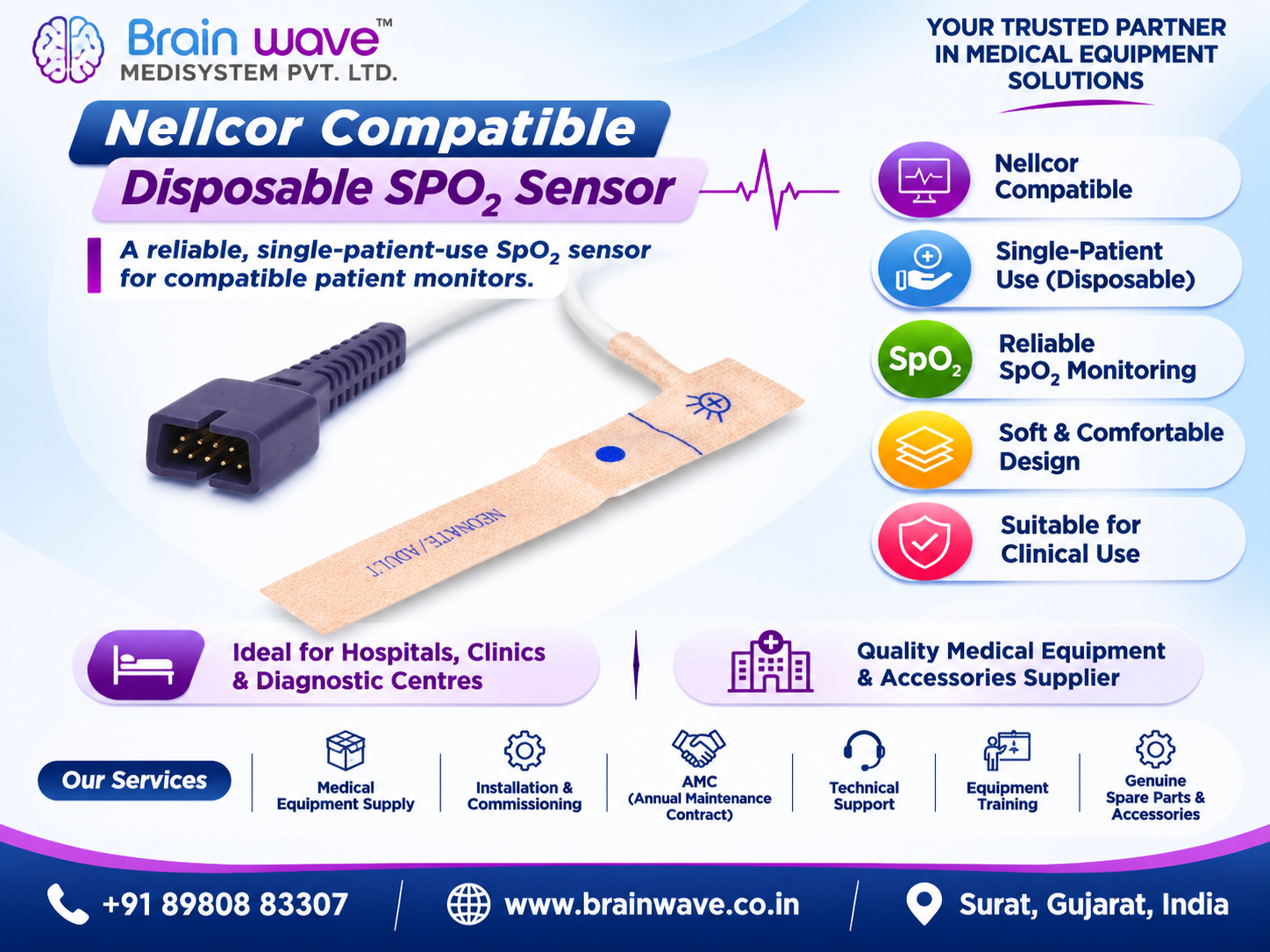
The Nellcor Compatible Disposable SpO₂ Sensor is designed for single-patient use with compatible patient monitoring equipment. Disposable sensors are useful in healthcare environments where infection-control procedures, patient turnover and accessory management are important considerations.
Choosing the correct disposable SpO₂ sensor involves checking its connector, monitoring technology, patient application and compatibility with the monitor.
Brainwave Medisystem Pvt. Ltd., based in Surat, Gujarat, India, supplies medical equipment and accessories to hospitals, clinics and healthcare facilities. Healthcare professionals and procurement teams can contact Brainwave Medisystem for enquiries about disposable SpO₂ sensors and other patient monitoring accessories.
What Is a Disposable SpO₂ Sensor?
A disposable SpO₂ sensor is a single-patient-use accessory designed to measure oxygen saturation and pulse rate when connected to a compatible monitoring device.
It generally uses optical components to detect changes in light absorption associated with oxygenated and deoxygenated haemoglobin. The connected monitor processes these signals and displays an estimated SpO₂ reading and pulse rate.
Unlike reusable sensors, disposable SpO₂ sensors are intended for use with one patient according to the manufacturer’s instructions. They are commonly considered by healthcare facilities that want to manage patient-specific monitoring accessories and follow established infection-prevention procedures.
Disposable sensors are available in different designs and patient sizes. The appropriate type depends on the patient’s age and size, the monitoring equipment and the intended application.
Understanding the Nellcor Compatible Disposable SpO₂ Sensor
The Nellcor Compatible Disposable SpO₂ Sensor is designed for use with supported Nellcor-compatible pulse oximetry and patient monitoring systems.
It provides a patient interface for collecting the optical signals needed for SpO₂ measurement. The sensor connects to the compatible monitoring system through its specified connector and cable arrangement.
The term Nellcor compatible is important when selecting this accessory. SpO₂ sensors are not universally interchangeable. Different monitors may use different connector arrangements, sensor technologies and signal-processing requirements.
Healthcare facilities should therefore confirm the exact monitor model and sensor compatibility before purchasing.
Key Features of a Nellcor Compatible Disposable SpO₂ Sensor
1. Disposable Single-Patient-Use Design
Disposable SpO₂ sensors are intended for use with one patient rather than repeated use across multiple patients.
This design can help healthcare facilities manage patient-specific accessories and follow their infection-control procedures.
The sensor should be discarded according to the manufacturer’s instructions and the hospital’s biomedical waste management policy.
2. Nellcor-Compatible Technology
Compatibility with the intended Nellcor monitoring system is an important selection requirement.
The sensor must match the monitor’s supported SpO₂ technology and connector configuration. A sensor should not be selected only because its connector appears physically similar.
3. Optical Measurement
SpO₂ sensors use light-based measurement to detect signals associated with blood oxygen saturation.
The connected monitor processes the detected signals and calculates the displayed oxygen saturation and pulse rate values.
4. Patient Monitoring Application
Disposable SpO₂ sensors can be used in clinical settings where continuous or intermittent oxygen saturation monitoring is required.
The appropriate sensor design must be selected according to the patient’s size and the manufacturer’s recommendations.
5. Cable and Connector Compatibility
The cable connects the sensor to the monitoring equipment. The connector must be suitable for the intended monitor or compatible extension cable.
Before ordering, verify the connector type, cable arrangement and exact monitor model.
6. Support for Infection-Control Procedures
Single-patient-use sensors can support patient-specific accessory management. They should be used, stored and disposed of according to the manufacturer’s instructions and the facility’s infection-control policies.
Why Is SpO₂ Monitoring Important?
SpO₂ monitoring provides an estimate of the oxygen saturation level in a patient’s blood. It is commonly used alongside other vital-sign measurements and clinical observations.
Monitoring Oxygen Saturation
Oxygen saturation readings help healthcare professionals assess a patient’s oxygenation status. The information can contribute to clinical evaluation when interpreted alongside the patient’s symptoms and condition.
Monitoring Pulse Rate
A pulse oximeter or compatible patient monitor can also display pulse rate. This provides additional information during patient observation.
Supporting Continuous Monitoring
Some patients require continuous monitoring in hospital environments. A compatible SpO₂ sensor helps connect the patient to the monitoring equipment.
Supporting Clinical Assessment
SpO₂ readings can help healthcare professionals identify changes that may require further assessment. The readings should always be interpreted in the context of the patient’s overall clinical condition.
Where Are Disposable SpO₂ Sensors Used?
Nellcor-compatible disposable SpO₂ sensors can be considered for suitable patient monitoring systems used in different healthcare departments.
1. Intensive Care Units (ICU)
ICUs care for patients who require close observation and specialised treatment. Oxygen saturation monitoring is commonly included in patient monitoring arrangements.
A compatible disposable sensor can be used when a single-patient-use accessory is required.
2. Operation Theatres
During surgical procedures, patient monitors are used to observe vital signs. SpO₂ monitoring is an important part of the monitoring process when clinically indicated.
3. Emergency Departments
Emergency departments assess patients who may require immediate medical attention. Oxygen saturation measurement can contribute to the initial and ongoing assessment of appropriate patients.
4. Recovery Rooms
Patients may require vital-sign monitoring after surgery or medical procedures. Disposable SpO₂ sensors can be considered for patient-specific monitoring requirements.
5. General Hospital Wards
Hospital wards may use multiparameter monitors to observe selected patient vital signs. A suitable disposable sensor can be used when required by the clinical team.
6. Specialised Healthcare Departments
Other clinical departments may also require disposable SpO₂ sensors depending on their patient-care requirements and monitoring equipment.
Disposable vs Reusable SpO₂ Sensors
Healthcare facilities may choose between disposable and reusable SpO₂ sensors depending on their clinical requirements and infection-control procedures.
| Consideration | Disposable SpO₂ Sensor | Reusable SpO₂ Sensor |
|---|---|---|
| Intended use | Single patient | Repeated use according to instructions |
| Patient allocation | Patient-specific | Can be used for different patients after approved cleaning |
| Cleaning | Follow disposal instructions | Requires approved cleaning and disinfection |
| Infection-control workflow | Supports single-patient-use procedures | Requires appropriate cleaning between patients |
| Replacement | Replaced after use as instructed | Replaced when damaged or no longer suitable |
| Selection | Must match monitor and patient | Must match monitor and patient |
Neither type is universally better. Healthcare facilities should select the sensor according to clinical requirements, manufacturer guidance, cost considerations and infection-control policies.
How to Choose the Correct Nellcor Compatible Disposable SpO₂ Sensor
Selecting the correct sensor is essential for reliable monitoring and suitable equipment operation.
1. Confirm the Monitor Model
Identify the exact patient monitor or pulse oximeter model. Check the manufacturer’s documentation for supported sensor types.
2. Verify SpO₂ Technology
Confirm that the sensor supports the measurement technology used by the monitoring device. Compatibility should be verified before ordering.
3. Check the Connector
Compare the sensor connector with the monitor’s required connector or approved extension cable. Do not force an incompatible connector into the monitor.
4. Select the Correct Patient Size
Disposable sensors may be available in adult, paediatric and neonatal configurations. Select the appropriate design according to the patient’s size and the manufacturer’s instructions.
5. Confirm Cable Requirements
Check the cable length and connector arrangement required for the intended bedside or clinical setup.
6. Review Packaging and Quantity
Healthcare procurement teams should confirm the number of sensors supplied per pack, packaging details and storage instructions.
7. Check Expiry and Product Condition
Review the product packaging, expiry information where applicable and physical condition before use. Do not use damaged or expired single-use accessories.
8. Confirm Supplier Support
Purchase from a supplier who can help clarify product specifications and compatibility requirements.
How to Use a Disposable SpO₂ Sensor
Disposable SpO₂ sensors should be used by trained healthcare staff according to the manufacturer’s instructions.
The general process includes the following steps:
Step 1: Inspect the Sensor
Check the packaging and sensor for visible damage. Confirm that the product is suitable for the intended patient and monitor.
Step 2: Prepare the Monitoring Equipment
Check that the patient monitor is operating correctly and supports the sensor being used.
Step 3: Connect the Sensor
Connect the sensor to the specified monitor port or approved cable arrangement. Avoid forcing the connector.
Step 4: Position the Sensor
Apply the sensor to the recommended measurement site according to the manufacturer’s instructions. Ensure that it is positioned correctly and securely.
Step 5: Check the Signal
Allow the monitor to detect the signal. Review the displayed SpO₂ and pulse rate information along with the available signal-quality indicators.
Step 6: Continue Patient Monitoring
Monitor the patient according to the clinical requirements. If readings appear inconsistent, check sensor placement, cable connections, patient movement and other possible causes.
Step 7: Dispose of the Sensor
After use, dispose of the sensor according to the manufacturer’s instructions and the hospital’s infection-control and biomedical waste procedures.
Factors That Can Affect SpO₂ Readings
Even when a suitable sensor is used, different factors may influence the readings.
Patient Movement
Movement can interfere with the optical signal and cause unstable readings.
Poor Peripheral Perfusion
Reduced blood flow at the measurement site can affect signal quality.
Incorrect Sensor Positioning
Incorrect placement may prevent the sensor from detecting an appropriate signal.
External Light
Strong external light may interfere with some sensor measurements. Follow the manufacturer’s instructions for correct placement and protection.
Damaged Cable or Connector
A damaged cable or loose connection may interrupt communication between the sensor and monitor.
Incompatible Sensor
A sensor that does not match the monitor’s technology or connector requirements may fail to operate correctly.
If the displayed reading does not match the patient’s clinical condition, healthcare professionals should assess the patient and follow the facility’s clinical protocol. SpO₂ values should not be interpreted in isolation.
Why Choose Brainwave Medisystem Pvt. Ltd.?
Healthcare facilities require suitable medical equipment and accessories to maintain their patient monitoring systems. Choosing the correct sensor involves checking compatibility, patient application, packaging and supplier support.
Brainwave Medisystem Pvt. Ltd., located in Surat, Gujarat, India, supplies medical equipment and accessories to hospitals, clinics and healthcare facilities.
The company’s services include:
- Medical equipment supply
- Installation and commissioning support
- Annual Maintenance Contract (AMC) support
- Technical assistance
- Equipment operation training
- Genuine spare parts and accessories
- Medical equipment-related guidance
Hospitals, diagnostic centres and healthcare procurement teams can contact Brainwave Medisystem for enquiries about disposable SpO₂ sensors and other patient monitoring accessories.
Frequently Asked Questions (FAQs)
1. What is a Nellcor Compatible Disposable SpO₂ Sensor?
It is a single-patient-use sensor designed to work with compatible Nellcor monitoring systems to measure oxygen saturation and pulse rate.
2. What is the purpose of a disposable SpO₂ sensor?
A disposable SpO₂ sensor connects a patient to a compatible monitoring device for pulse oximetry measurement. It is intended for use with one patient according to the manufacturer’s instructions.
3. Can a Nellcor-compatible sensor work with every patient monitor?
No. Compatibility depends on the monitor model, connector arrangement and supported SpO₂ technology. Always verify compatibility before purchasing.
4. What is the difference between disposable and reusable SpO₂ sensors?
Disposable sensors are intended for single-patient use. Reusable sensors can be used for different patients when cleaned and disinfected according to the manufacturer’s instructions.
5. Where are disposable SpO₂ sensors commonly used?
They may be used in ICUs, operation theatres, emergency departments, recovery rooms and hospital wards where compatible patient monitoring equipment is available.
6. Are disposable SpO₂ sensors available in different patient sizes?
Disposable sensors may be available in different patient configurations, including adult, paediatric and neonatal designs. The exact product should be selected according to the patient’s size and manufacturer instructions.
7. Can a disposable SpO₂ sensor be reused?
A sensor labelled for single-patient use should not be reused on another patient. Follow the manufacturer’s instructions and the healthcare facility’s infection-control policy.
8. What should be checked before purchasing a Nellcor-compatible sensor?
Check the monitor model, SpO₂ technology, connector type, patient application, cable arrangement and product packaging.
9. What can cause inaccurate SpO₂ readings?
Patient movement, poor peripheral perfusion, incorrect positioning, external light interference, damaged cables and incompatible sensors can affect measurement quality.
10. Where can I enquire about disposable SpO₂ sensors?
You can contact Brainwave Medisystem Pvt. Ltd. in Surat, Gujarat, India, for product enquiries and medical equipment accessory requirements.
Conclusion
The Nellcor Compatible Disposable SpO₂ Sensor is a patient monitoring accessory intended for single-patient use with compatible pulse oximetry and patient monitoring equipment. It can support oxygen saturation and pulse rate monitoring in healthcare environments where disposable accessories are required.
Before purchasing, healthcare facilities should confirm the monitor model, connector configuration, SpO₂ technology and patient application. Correct sensor selection and use are important for obtaining suitable monitoring signals.
Brainwave Medisystem Pvt. Ltd., Surat, Gujarat, supplies medical equipment and accessories to hospitals, clinics and healthcare facilities. Contact the team for enquiries about Nellcor-compatible disposable SpO₂ sensors and other patient monitoring accessories.
Contact Brainwave Medisystem Pvt. Ltd.
Company: Brainwave Medisystem Pvt. Ltd.
Location: Surat, Gujarat, India
Phone: +91 89808 83307
Website: https://brainwave.co.in/