
Fetal Doppler for Clear and Reliable Fetal Heart Monitoring
Fetal monitoring plays an important role in prenatal care, where healthcare professionals need dependable equipment to assess fetal heart activity during appropriate clinical examinations. A Fetal Doppler is a compact ultrasound-based monitoring device designed to detect and provide audible fetal heart sounds. With a portable design, straightforward controls, and a dedicated Doppler probe, it can support healthcare professionals during routine prenatal assessments. For hospitals, maternity clinics, diagnostic centres, and healthcare facilities, selecting suitable fetal monitoring equipment can contribute to an efficient examination workflow and a better clinical experience. Brain Wave Medisystem Pvt. Ltd. offers a wide range of medical equipment for hospitals and healthcare professionals, including Fetal Doppler and Fetal Monitor solutions.
Understanding Fetal Doppler Technology
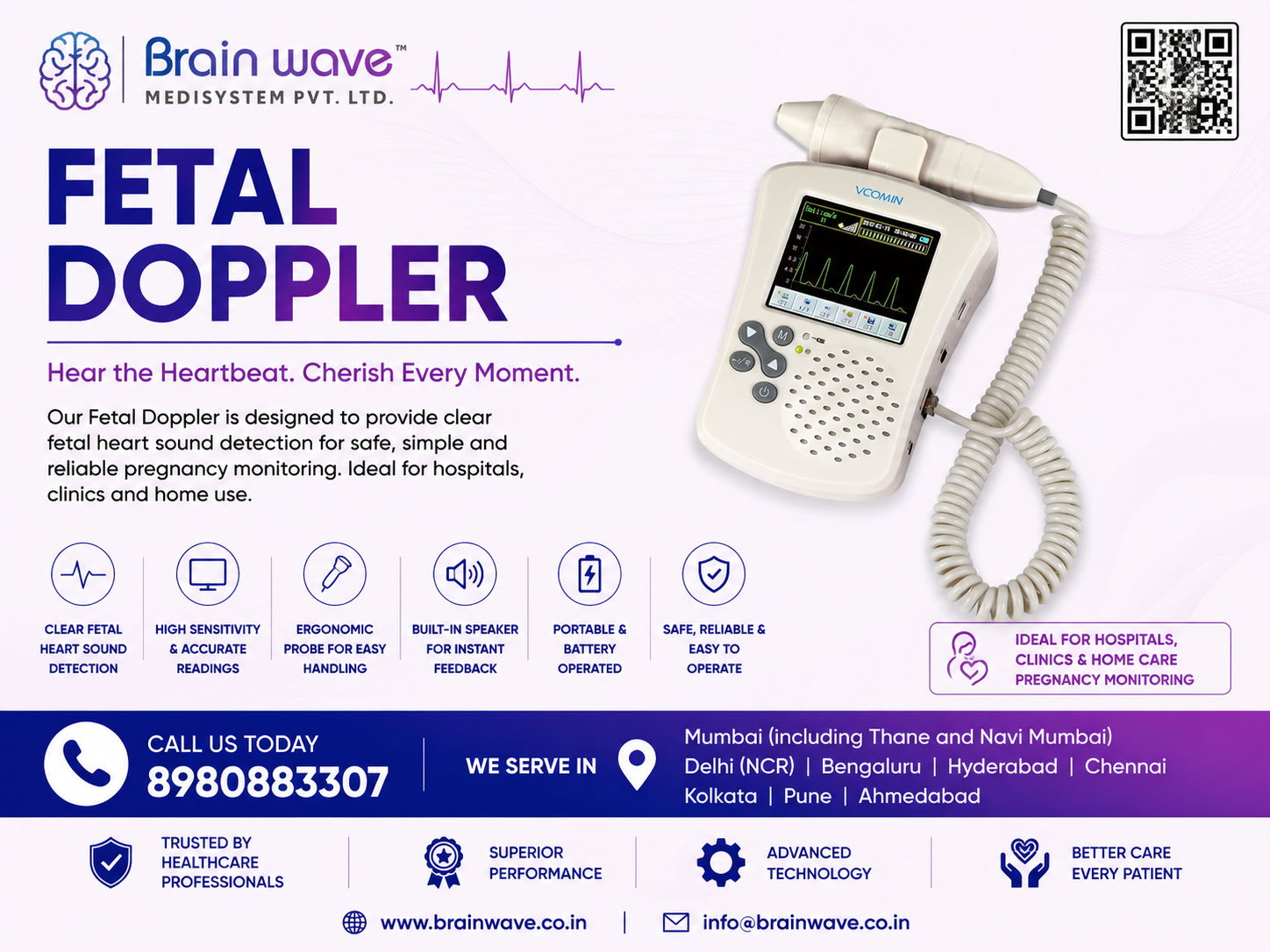
A Fetal Doppler uses Doppler ultrasound technology to detect movement associated with fetal cardiac activity and convert the detected signals into audible sound. This allows an appropriately trained healthcare professional to listen to fetal heart sounds during a prenatal examination. The technology is particularly useful when a compact and portable monitoring solution is preferred. Unlike larger fetal monitoring systems that may provide extensive graphical and data-monitoring capabilities, a handheld or compact Doppler can offer a convenient approach for focused fetal heart sound assessment. The device shown in the accompanying creative represents a professional fetal Doppler designed around a display, control interface, speaker, and probe-based monitoring system.
Why Fetal Heart Sound Monitoring Matters
Fetal heart activity is an important component of prenatal assessment. During a clinical examination, healthcare professionals may use appropriate monitoring equipment alongside other examination methods to evaluate fetal wellbeing. A Fetal Doppler provides an audible representation of detected fetal heart activity, allowing the healthcare professional to hear the heart sounds during the examination. It should be considered a professional monitoring tool rather than a replacement for complete prenatal assessment or diagnostic evaluation. The choice of equipment should depend on the clinical environment, intended application, user training, and the recommendations of qualified healthcare professionals.
Clear Sound for Practical Clinical Use
One of the most useful characteristics of a Fetal Doppler is its ability to provide audible fetal heart sounds through an integrated speaker or compatible audio output. Clear sound can make the examination process more convenient for trained users. Brain Wave’s website lists fetal Doppler products with features such as sensitive Doppler probes, real-time waveform and parameter display on selected models, battery operation, automatic power-off functionality, and speaker or earphone output. These features demonstrate how modern Doppler devices can combine monitoring functionality with practical usability.
Portable Design for Flexible Monitoring
Portability is another important consideration when choosing fetal monitoring equipment. A compact Doppler can be easier to move between examination rooms, consultation areas, maternity units, and other suitable healthcare environments. Battery-powered operation can further improve flexibility where mains power is not immediately available. Depending on the specific model, fetal Doppler devices may be suitable for hospitals, clinics, community healthcare settings, and other professional environments where fetal heart sound assessment is required. Brain Wave’s product range includes portable fetal Doppler solutions intended for different healthcare applications.
User-Friendly Operation
Medical equipment needs to be practical for healthcare professionals who use it as part of their daily workflow. A well-designed Fetal Doppler can combine a readable display, accessible controls, a purpose-designed probe, and an integrated speaker to simplify routine operation. A straightforward interface can help users focus on the examination rather than complicated device controls. Features such as automatic power-off can also help conserve battery power when the equipment is not being used. The exact functions and specifications vary between models, so healthcare facilities should always review the manufacturer’s product information before selecting a device.
Fetal Doppler for Hospitals and Clinics
Hospitals and maternity clinics often require different types of fetal monitoring equipment depending on their patient-care workflow. A compact Doppler can be useful for focused fetal heart sound assessment, while a full fetal monitor or CTG system may be more appropriate when continuous fetal heart rate and uterine contraction monitoring is required. Brain Wave’s product catalogue includes both Fetal Doppler and Fetal Monitor categories, allowing healthcare institutions to consider equipment according to their specific requirements.
For example, Brain Wave lists the Bistos BT350 Fetal Monitor with features including fetal heart rate display, uterine contraction measurement, trend data storage, thermal printing, and optional connectivity features. This illustrates the difference between a focused Doppler device and a more comprehensive fetal monitoring system.
Choosing the Right Fetal Doppler
When selecting a Fetal Doppler, healthcare facilities should consider several factors. Probe sensitivity is important because the probe is responsible for detecting the relevant Doppler signals. Display readability can be valuable when the device provides numerical or waveform information. Audio quality is another consideration because clear sound supports practical examination. Battery operation can improve portability, while automatic power-off may help conserve battery life. Healthcare professionals should also consider build quality, availability of accessories, service support, warranty terms, and compatibility with their intended clinical environment.
The website’s FAQ states that Brain Wave provides installation and training assistance, technical support, servicing, maintenance, and warranty options for its medical equipment. This type of after-sales support can be an important consideration for hospitals and clinics investing in medical equipment.
Fetal Doppler for Modern Prenatal Care
Modern healthcare environments increasingly require equipment that combines functionality, portability, and ease of use. A Fetal Doppler can fit into this requirement by providing a compact solution for fetal heart sound assessment when used by trained healthcare professionals. Its relatively small form factor can make it convenient for routine examinations and different clinical environments. However, fetal Doppler readings or sounds should always be interpreted by qualified healthcare professionals within the appropriate clinical context.
It is also important to remember that hearing a fetal heartbeat does not by itself provide a complete assessment of fetal health. A healthcare professional may require additional examinations, monitoring, imaging, or diagnostic procedures depending on the pregnancy and clinical circumstances. For this reason, fetal Doppler equipment should be viewed as one component of professional prenatal assessment rather than a standalone diagnostic solution.
Why Choose Brain Wave Medisystem?
Brain Wave Medisystem Pvt. Ltd. focuses on providing medical equipment and healthcare solutions across multiple product categories. Its online catalogue covers hospital equipment such as fetal Dopplers, fetal monitors, oxygen concentrators, CPAP and BiPAP devices, ECG equipment, patient monitors, pulse oximeters, infusion pumps, defibrillators, and other medical equipment and accessories.
The company also highlights services such as delivery across India, customer support, installation assistance, training, servicing, and maintenance. For healthcare institutions, these services can be valuable when purchasing equipment that needs to remain available and functional as part of regular clinical operations.
Final Thoughts
A Fetal Doppler can be a practical addition to professional prenatal monitoring when selected according to clinical requirements and used by appropriately trained healthcare personnel. Its combination of Doppler-based fetal heart sound detection, portable operation, dedicated probe technology, and convenient audio output makes it suitable for focused fetal monitoring applications. Healthcare providers should select equipment based on intended use, technical specifications, user requirements, service support, and applicable clinical standards.
With a broad medical-equipment portfolio and dedicated healthcare support, Brain Wave Medisystem Pvt. Ltd. provides fetal monitoring equipment alongside a wider range of hospital and clinical solutions.