
Introduction
Accurate medication delivery is an essential part of patient care in hospitals and other healthcare facilities. Certain treatments require medicines to be administered at carefully controlled rates and volumes. In these situations, a syringe pump helps healthcare professionals manage the delivery of medication through a syringe according to prescribed settings.
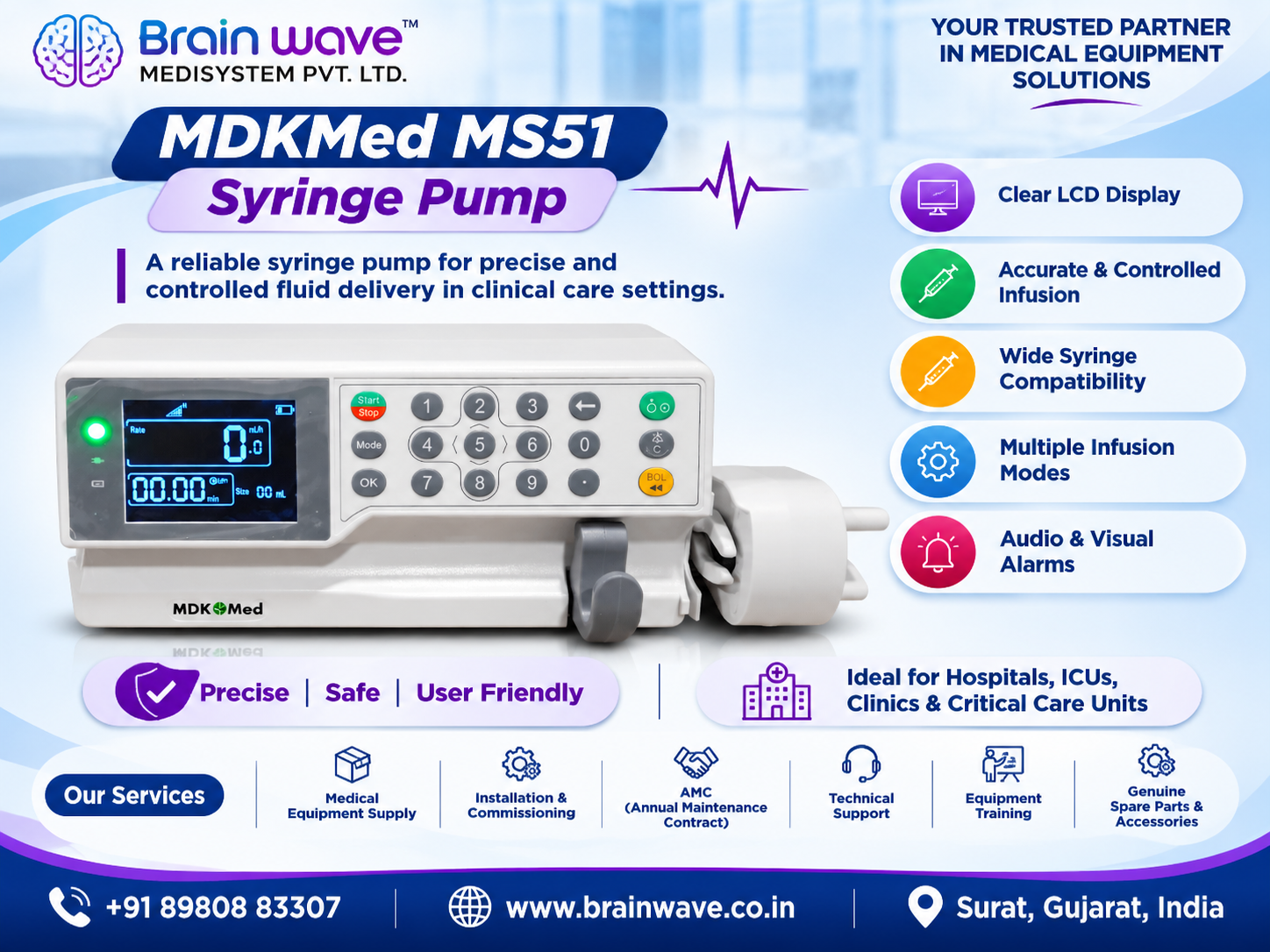
The MDKMed MS51 Syringe Pump is designed for controlled syringe-based infusion. It features a compact and lightweight design, visual alarm information, controlled injection speed and volume, and optional touchscreen operation. Its product listing specifies injection speed and volume precision within ±2%.
The device also offers optional wireless Wi-Fi connectivity for integration with hospital information systems and nurse stations. Its listed specifications include a 1.5 kg weight, approximately six hours of battery backup and an infusion flow-rate range of 0.1–400 ml/hour.
Brainwave Medisystem Pvt. Ltd., based in Surat, Gujarat, India, supplies medical equipment to hospitals, clinics and healthcare facilities. Healthcare professionals and procurement teams looking for the MDKMed MS51 Syringe Pump can contact Brainwave Medisystem for product enquiries and related assistance.
What Is a Syringe Pump?
A syringe pump is a medical device used to deliver medication or fluids from a syringe at a controlled rate. It is particularly useful when treatment requires a specific quantity of fluid to be administered over a defined period.
The device uses a controlled mechanical mechanism to move the syringe plunger. The movement determines how quickly the fluid is delivered through the connected infusion line.
Syringe pumps are commonly used in intensive care units, operation theatres, emergency departments and other clinical areas where controlled medication delivery is required.
The healthcare professional selects the appropriate syringe and configures the infusion settings according to the prescription and the patient’s clinical requirements.
A syringe pump supports medication administration but does not replace clinical supervision. Correct settings, suitable syringe selection, equipment checks and patient monitoring remain essential.
Introduction to the MDKMed MS51 Syringe Pump
The MDKMed MS51 is a syringe infusion pump designed to provide controlled medication delivery in healthcare environments.
Its product description highlights three main areas:
- Lightweight and easy-to-use design
- Controlled injection speed and volume
- Optional information connectivity through wireless Wi-Fi
The device is designed with a compact structure to save bedside space. It supports push-button operation, while a touchscreen option is also listed.
Its visual alarm information helps operators identify the cause of an alarm. The product description also highlights intelligent occlusion-bolus protection and multiple injection models.
These features make the MS51 a product worth considering for hospitals and healthcare facilities evaluating syringe infusion equipment.
Key Features of the MDKMed MS51 Syringe Pump
1. Lightweight and Compact Design
The MDKMed MS51 has a compact structure intended to save bedside space. Its listed weight is approximately 1.5 kg, making it relatively lightweight for clinical equipment.
A compact design can be useful in healthcare environments where several medical devices may need to be positioned around a patient’s bed.
2. Optional Touchscreen and Push-Button Operation
The product description identifies a push-button operation model and an optional touchscreen configuration.
The operating interface is intended to make the equipment easier to understand and use. Healthcare facilities should confirm the exact configuration being supplied before ordering, particularly if touchscreen operation is required.
3. Controlled Injection Speed and Volume
The MS51 product listing specifies injection speed and injection volume precision within ±2%.
Controlled delivery is an important consideration when selecting a syringe pump. The actual performance of the equipment depends on correct calibration, syringe compatibility, operating conditions and the manufacturer’s instructions.
4. Visual Alarm Information
The device provides visual alarm information to help operators identify the cause of an alarm.
Alarm visibility is important in clinical environments because staff need to recognise conditions that require attention. Operators should understand the alarm messages and follow the recommended response procedures.
5. Intelligent Occlusion-Bolus Protection
The product description highlights intelligent occlusion-bolus protection.
Occlusion refers to a blockage or restriction in the infusion pathway. When pressure builds up because of a blockage, an occlusion-related condition may require operator attention.
The MS51’s listed protection feature is intended to help reduce the risk associated with an occlusion bolus. Staff must still inspect the infusion line and follow the manufacturer’s instructions when an alarm occurs.
6. Multiple Injection Models
The MS51 is described as supporting multiple injection models to meet different injection requirements across clinical departments.
The exact operating modes and available settings should be confirmed from the manufacturer’s user manual for the supplied configuration.
7. Optional Wireless Wi-Fi Connectivity
The product description identifies optional wireless Wi-Fi networking.
This option may allow connection to a hospital information system (HIS), nurse station or other supported hospital network arrangement. The listing also describes remote transmission of injection information and history downloads.
Because this is an optional feature, healthcare facilities should confirm whether the supplied MS51 configuration includes wireless connectivity and whether it is compatible with their existing hospital systems.
8. Rechargeable Battery Backup
The product listing specifies approximately six hours of battery backup.
Battery operation can support equipment use when the device is not connected to its main AC power supply. Actual backup time can depend on battery condition and operating conditions.
Facilities should check battery status and charging requirements as part of their routine equipment preparation.
Technical Specifications of the MDKMed MS51 Syringe Pump
The following specifications are based on the MDKMed MS51 product listing published by Brainwave Medisystem.
| Specification | Details |
|---|---|
| Product name | MDKMed MS51 Syringe Pump |
| Model | MS 51 |
| Brand | MDKMed |
| Device type | Syringe pump |
| Listed syringe size | 10 ml |
| Accuracy | ±2% |
| Flow rate | 0.1–400 ml/hour |
| Volume infused | 0.1–9,999.9 ml |
| Volume increment | 0.1 ml |
| Display/operation | Push-button; touchscreen optional |
| Weight | 1.5 kg |
| Dimensions | 278 × 145 × 106 mm (W × D × H) |
| Power supply | AC 100–240V, 50/60Hz |
| Power consumption | 55 VA |
| Battery backup | Approximately 6 hours |
| Battery voltage | 10.8V |
| Classification | Class II, Type CF, IPX2 |
Important: The Brainwave Medisystem product listing specifies a 10 ml syringe size. Other online listings describe additional syringe-size configurations. Confirm the exact syringe compatibility and configuration of the unit being supplied before purchase.
Applications of the MDKMed MS51 Syringe Pump
Syringe pumps are used in clinical environments where medication delivery needs to be controlled. The MS51 can be evaluated by healthcare facilities according to their treatment requirements and equipment policies.
1. Intensive Care Units (ICU)
Intensive care units manage patients who require close observation and specialised treatment. Syringe pumps may be used when medication needs to be administered at a controlled rate according to a clinician’s prescription.
2. Operation Theatres
Operation theatres use different medical devices to support surgical procedures and patient management. Syringe pumps can be part of the equipment setup when controlled syringe-based medication delivery is required.
3. Emergency Departments
Emergency departments handle patients who may need prompt assessment and treatment. Syringe pumps may be used when a healthcare professional prescribes controlled medication administration.
4. General Hospital Wards
Hospital wards may require syringe pumps for selected treatments where medication delivery needs to be controlled. Equipment selection should consider the clinical requirements and staff training available.
5. Specialised Clinical Departments
Specialised departments may also use syringe pumps depending on the type of treatment provided. The facility should confirm that the equipment’s configuration is appropriate for its intended clinical application.
Why Is Controlled Medication Delivery Important?
Some medicines need to be administered at specific rates and volumes. Incorrect delivery settings can affect the intended treatment, making appropriate equipment selection and operation important.
A syringe pump helps healthcare professionals manage the delivery process through configured settings.
Important considerations include:
- Correct medication and concentration
- Appropriate syringe selection
- Correct infusion rate and volume
- Proper syringe installation
- Correct infusion-line connections
- Appropriate equipment calibration
- Regular monitoring of the pump and patient
- Prompt response to equipment alarms
The MS51’s listed precision of ±2% is one of the specifications buyers may consider. However, the actual delivery performance must be assessed under the manufacturer’s stated conditions and instructions.
The device should only be configured and operated by appropriately trained healthcare professionals.
Benefits of a Compact Syringe Pump in Hospitals
Hospitals often have limited bedside space, particularly in intensive care and other specialised departments. Compact equipment can help facilities organise their clinical work areas.
The MDKMed MS51 has a listed weight of 1.5 kg and dimensions of 278 × 145 × 106 mm.
Its compact design may offer practical benefits such as:
- Efficient use of bedside space
- Easier equipment positioning
- Convenient handling by trained staff
- Integration into suitable clinical equipment arrangements
Before purchasing, healthcare facilities should consider the pump’s mounting requirements and confirm whether the supplied accessories match their intended setup.
Importance of Alarm Systems in Syringe Pumps
Alarm systems are important because they alert healthcare staff to conditions that may require attention during infusion.
The MS51 product description highlights visual alarm information. Operators should be trained to recognise alarm indications and respond according to the device manual and hospital protocol.
Common syringe-pump alarm conditions that healthcare facilities should consider when evaluating equipment include:
- Occlusion or infusion-line blockage
- Incorrect syringe installation
- Syringe or plunger positioning issues
- Low battery
- End of infusion
- Equipment malfunction
The exact alarm types and functions available on the supplied MS51 configuration should be confirmed with the manufacturer or supplier.
An alarm system is an additional safety feature. It does not replace patient monitoring, proper equipment checks or clinical supervision.
Optional Connectivity and Hospital Information Systems
Modern healthcare facilities increasingly use digital systems to manage patient information and clinical workflows.
The MDKMed MS51 product description identifies optional wireless Wi-Fi connectivity for supported connections with hospital information systems and nurse stations.
The listed connectivity features include:
- Wireless Wi-Fi networking
- Connection with supported hospital information systems
- Connection with nurse station arrangements
- Remote transmission of injection information
- Downloading of historical information
These capabilities are optional and should not be assumed to be included in every unit.
Hospitals planning to use network connectivity should confirm the required hardware, software compatibility, network requirements and configuration support before purchasing.
What to Consider Before Buying the MDKMed MS51 Syringe Pump?
Choosing a syringe pump requires evaluating the equipment according to the hospital’s clinical and operational needs.
1. Syringe Compatibility
Confirm the syringe sizes and brands supported by the exact MS51 configuration. The Brainwave product listing specifies a 10 ml syringe size, so buyers should verify compatibility if they require other capacities.
2. Accuracy Requirements
Review the manufacturer’s stated accuracy and the conditions under which it applies. The product listing specifies ±2% precision.
3. Operating Interface
Confirm whether the supplied unit has push-button operation or the optional touchscreen configuration.
4. Flow-Rate Requirements
Compare the pump’s listed flow-rate range with the requirements of the intended clinical applications. The product listing specifies 0.1–400 ml/hour.
5. Battery Backup
Check the battery condition, charging requirements and expected backup time. The listing specifies approximately six hours of battery backup.
6. Alarm Features
Review the available alarms and confirm that the clinical team understands their indications and response procedures.
7. Connectivity Requirements
If the facility needs integration with an HIS or nurse station, confirm that the optional Wi-Fi configuration is available and compatible with the hospital’s systems.
8. Technical Support and Warranty
Ask about warranty coverage, service arrangements, maintenance requirements and availability of technical assistance.
9. Total Cost of Ownership
Consider the purchase price along with accessories, servicing, battery replacement and other operating requirements.
Maintenance Tips for the MDKMed MS51 Syringe Pump
Regular equipment maintenance helps healthcare facilities manage their medical devices and reduce avoidable interruptions.
1. Clean the Equipment According to Instructions
Clean the pump’s exterior according to the manufacturer’s recommendations and the facility’s infection-control procedures. Do not use unapproved cleaning agents.
2. Inspect the Syringe Mechanism
Check the syringe holder, plunger mechanism and accessible components for visible damage or unusual movement.
3. Check the Battery
Monitor battery condition and charging status. Follow the manufacturer’s recommendations for battery care and replacement.
4. Inspect the Power Supply
Check power cables and connectors for visible wear or damage. Use compatible power accessories.
5. Review Alarm Operation
Follow the recommended inspection procedure for the available alarm functions. Report suspected alarm problems to qualified technical personnel.
6. Follow Calibration Requirements
Follow the manufacturer’s recommended calibration and technical inspection schedule. Repairs and adjustments should only be carried out by authorised or qualified personnel.
7. Maintain Service Records
Record equipment inspections, repairs, battery replacements and servicing. This helps healthcare facilities maintain an organised equipment history.
Why Choose Brainwave Medisystem Pvt. Ltd.?
Selecting a medical equipment supplier involves more than comparing products. Healthcare facilities also need information about installation, operation, maintenance and after-sales support.
Brainwave Medisystem Pvt. Ltd., based in Surat, Gujarat, India, supplies medical equipment and supports hospitals, clinics and other healthcare facilities.
The company’s services include:
- Medical equipment supply
- Installation and commissioning support
- Annual Maintenance Contract (AMC) support
- Technical assistance
- Equipment operation training
- Genuine spare parts and accessories
- Medical equipment-related guidance
Whether a hospital is planning to equip a new department or replace existing infusion equipment, Brainwave Medisystem can assist with product enquiries and related requirements.
Contact the team to enquire about the MDKMed MS51 Syringe Pump.
Frequently Asked Questions (FAQs)
1. What is the MDKMed MS51 Syringe Pump?
The MDKMed MS51 is a syringe infusion pump designed to deliver fluids from a syringe at a controlled rate according to the configured settings.
2. What is the accuracy of the MDKMed MS51?
The Brainwave Medisystem product listing specifies injection speed and volume precision within ±2%. Actual performance depends on the manufacturer’s specified operating and calibration conditions.
3. What syringe size is listed for the MS51?
The Brainwave product listing specifies a 10 ml syringe size. Other configurations may be described by different sellers, so confirm the exact compatibility of the unit before purchasing.
4. Does the MDKMed MS51 have a touchscreen?
The product description lists push-button operation and an optional touchscreen configuration. Confirm which version is being supplied.
5. How much does the MDKMed MS51 weigh?
The listed weight is approximately 1.5 kg.
6. What is the battery backup of the MS51?
The product listing specifies approximately six hours of battery backup. Actual performance may depend on battery condition and operating conditions.
7. Does the MDKMed MS51 support Wi-Fi connectivity?
Optional wireless Wi-Fi networking is listed as a feature. It may support connections with compatible hospital information systems and nurse station arrangements. Confirm availability and compatibility before ordering.
8. What is the flow-rate range of the MDKMed MS51?
The Brainwave Medisystem product listing specifies a flow-rate range of 0.1–400 ml/hour.
9. Where can the MDKMed MS51 Syringe Pump be used?
Syringe pumps may be used in intensive care units, operation theatres, emergency departments and other clinical areas where controlled medication delivery is required.
10. Where can I enquire about the MDKMed MS51 Syringe Pump?
You can contact Brainwave Medisystem Pvt. Ltd. in Surat, Gujarat, India, through its website or phone number for product enquiries.
Conclusion
The MDKMed MS51 Syringe Pump is a compact syringe infusion device designed for controlled medication delivery. Its listed features include ±2% injection speed and volume precision, visual alarm information, optional touchscreen operation, intelligent occlusion-bolus protection and optional wireless connectivity.
With a listed weight of 1.5 kg and approximately six hours of battery backup, it is a product that hospitals and healthcare facilities can evaluate according to their infusion requirements.
Before purchasing, confirm the exact syringe compatibility, operating configuration, available alarm functions, connectivity options, warranty and service arrangements.
Brainwave Medisystem Pvt. Ltd., Surat, Gujarat, supplies medical equipment and provides related support services for healthcare facilities. Contact the team to enquire about the MDKMed MS51 Syringe Pump and discuss your hospital equipment requirements.
Contact Brainwave Medisystem Pvt. Ltd.
Company: Brainwave Medisystem Pvt. Ltd.
Location: Surat, Gujarat, India
Phone: +91 89808 83307
Website: https://brainwave.co.in/