
Introduction
Newborn and infant care requires medical equipment that is designed specifically for the needs of smaller and more vulnerable patients. During situations where assisted ventilation is required, healthcare professionals need dependable respiratory equipment that can be readily available and practical to operate. A Silicone Resuscitator Infant/Neonate is designed to provide manual ventilation support for infants and neonates and can form an important part of respiratory-care equipment in hospitals, clinics, emergency-care environments and newborn-care areas.
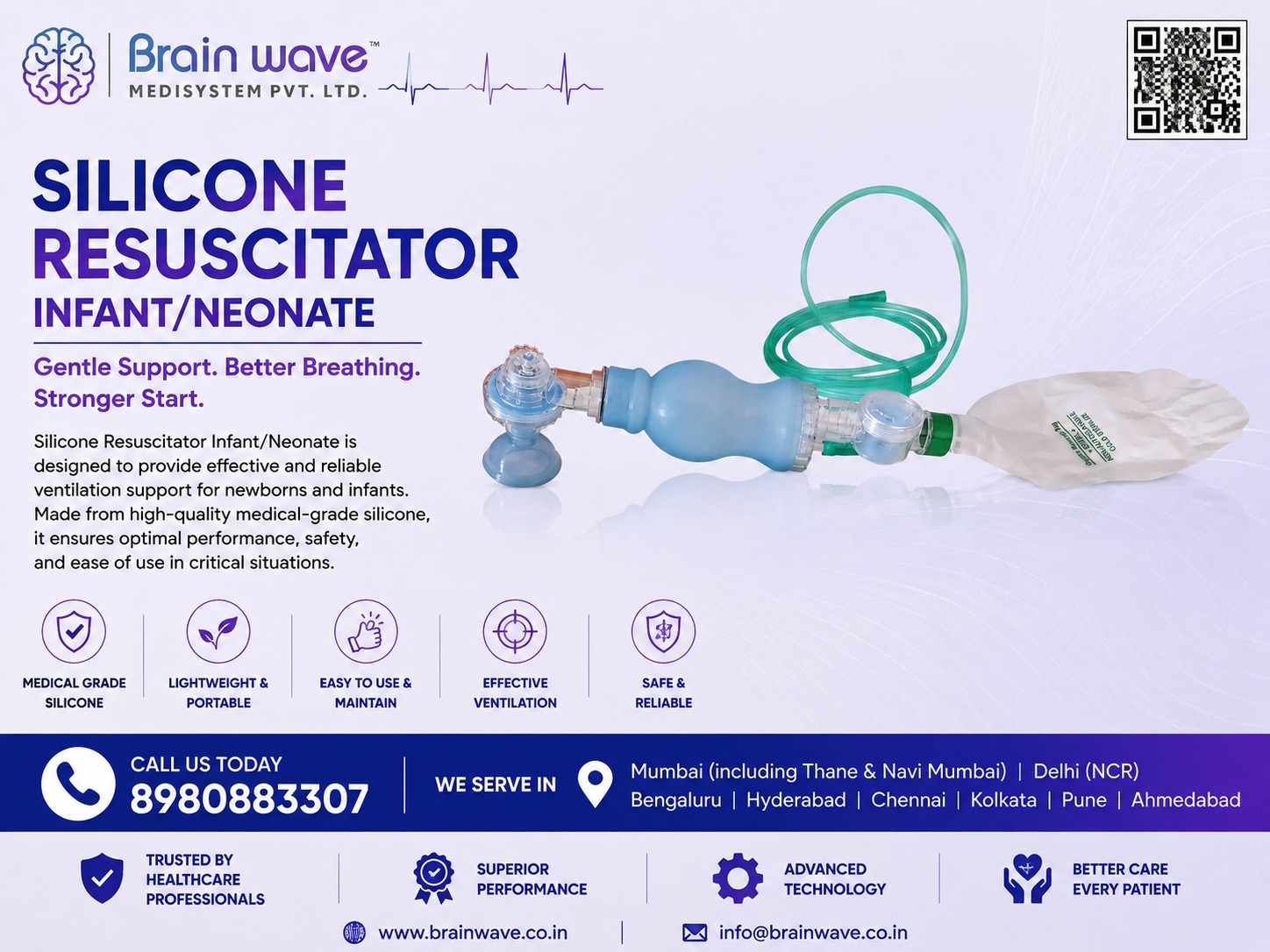
Brain Wave Medisystem Pvt. Ltd. offers a Silicone Resuscitator Infant/Neonate designed with a silicone construction and supplied as a complete respiratory-care solution with a face mask, oxygen tube and reservoir bag. The product is listed on the company’s website under the Respiratory Care category and is intended for use in personal, clinic and hospital environments.
What Is a Silicone Resuscitator for Infants and Neonates?
A silicone resuscitator is a manually operated ventilation device used to provide assisted breaths when a patient requires respiratory support. The Infant/Neonate Silicone Resuscitator is designed specifically for smaller patients, making appropriate sizing an important consideration when selecting respiratory-care equipment.
Unlike general-purpose adult resuscitation equipment, neonatal and infant resuscitation equipment needs to be appropriately configured for the smaller patient population. The Brain Wave product is supplied with an infant/neonate-oriented configuration, including a face mask and a 250 ml resuscitator capacity. The product page also specifies a 60 cm H₂O pop-off valve, which is part of the device configuration.
Importance of Appropriate Respiratory Equipment in Neonatal Care
Respiratory support can be required in different clinical circumstances involving newborns and infants. Having appropriate equipment readily available allows trained healthcare professionals to respond according to established clinical protocols.
In hospitals, neonatal care units, emergency departments and other clinical environments, respiratory equipment is generally kept accessible so that trained personnel can use it when clinically indicated. The selection of appropriately sized equipment is especially important for infants and neonates because their respiratory requirements differ from those of adults and older children.
A dedicated neonatal resuscitator can therefore be a valuable component of a properly equipped respiratory-care setup.
Medical-Grade Silicone Construction
The material used in a resuscitator is an important consideration for healthcare facilities. The Brain Wave Infant/Neonate Resuscitator is made from silicone rubber, according to the product information. The listed product colour is white, while the website states that the silicone artificial resuscitator is available in colours including green, white and blue.
Silicone-based construction is commonly valued in reusable medical equipment because of its flexibility and suitability for healthcare applications. For hospitals and clinical facilities, equipment should be handled, cleaned and maintained according to the manufacturer’s instructions and applicable infection-control procedures.
Complete Infant/Neonate Resuscitator Configuration
One of the practical benefits of the Brain Wave Silicone Resuscitator Infant/Neonate is that it is supplied as a complete configuration rather than simply as an isolated resuscitation bag. The product includes a face mask, reservoir bag and oxygen tube, helping provide the components required for its intended respiratory-support setup.
The product specifications list a 600 ml reservoir bag and a 2 metre oxygen tube. The resuscitator itself has a listed capacity of 250 ml. These specifications make it important for healthcare purchasers to select the correct product configuration according to the intended patient group and clinical requirements.
Infant and Neonatal Applications
The Silicone Resuscitator Infant/Neonate is designed for use with infant and neonatal patients. It can be considered for healthcare environments where manual ventilation equipment needs to be available as part of respiratory-care preparedness.
Potential healthcare settings may include hospitals, clinics, newborn-care areas, emergency departments and other suitable clinical environments. The product page specifically identifies personal, clinic and hospital use under its usage/application information.
The device should only be used by appropriately trained healthcare professionals and according to established clinical procedures.
Portable and Convenient Storage
Medical equipment used for emergency respiratory support needs to be readily accessible. The Brain Wave Silicone Resuscitator Infant/Neonate is supplied in a carry bag with zip lock, according to the product specifications.
A dedicated storage bag can help healthcare facilities keep the components together and facilitate organized storage. Proper storage also helps protect the equipment from unnecessary exposure and makes it easier for trained personnel to locate the resuscitator when required.
Reusable Design
The product information identifies the Silicone Resuscitator Infant/Neonate as reusable. Reusable medical equipment requires appropriate cleaning, disinfection, inspection and maintenance procedures between uses, following the manufacturer’s instructions and the healthcare facility’s infection-control protocols.
For hospitals and clinics, maintaining a structured equipment-care process is essential. Reusable respiratory equipment should be checked regularly to ensure that all components are present and that the device is maintained appropriately for its intended use.
Pop-Off Valve and Patient-Specific Considerations
The product specifications list a 60 cm H₂O pop-off valve as part of the 250 ml resuscitator configuration. Features such as valves and patient-specific sizing are important considerations when selecting respiratory equipment.
Healthcare professionals should always use the equipment according to the manufacturer’s instructions and applicable clinical protocols. Correct technique, appropriate mask selection, patient assessment and professional training remain essential when using any manual resuscitation device.
Why Hospitals Need Dedicated Neonatal Respiratory Equipment
Hospitals and neonatal-care facilities need to be prepared for a range of patient-care situations. Respiratory equipment is one of the important categories that should be considered when developing and maintaining emergency and neonatal-care resources.
A dedicated Infant/Neonate Resuscitator helps healthcare facilities maintain equipment specifically intended for smaller patients. Having appropriately sized equipment available can support clinical preparedness and help trained healthcare professionals respond efficiently when respiratory assistance is clinically required.
For healthcare procurement teams, factors such as patient category, equipment configuration, material, accessories, storage, maintenance and supplier support should all be considered before purchasing respiratory-care equipment.
Choosing a Silicone Resuscitator for Neonatal Care
When selecting a neonatal resuscitator, healthcare institutions should consider whether the device is designed for the intended patient group and whether its configuration meets their clinical requirements. The type and size of face mask, resuscitator capacity, reservoir configuration, oxygen tubing, valve arrangement and storage method can all be relevant purchasing considerations.
The Brain Wave product provides a 250 ml resuscitator, 600 ml reservoir bag, 2 metre oxygen tube, face mask and carry bag as part of its listed configuration. Healthcare buyers should verify the latest specifications, configuration and availability directly with the supplier before procurement.
Brain Wave Medisystem – Respiratory Care Equipment
Brain Wave Medisystem Pvt. Ltd. offers a broad range of hospital equipment and accessories. Its website includes categories covering hospital equipment as well as hospital equipment accessories, with respiratory-care products forming part of the accessories range.
The company’s website also features categories such as ECG equipment, fetal monitoring, pulse oximeters, infusion equipment, defibrillators, suction machines, oxygen concentrators and other hospital equipment, providing healthcare institutions with access to multiple medical-equipment categories.
For hospitals, clinics, medical dealers and healthcare procurement teams, having access to a broad product portfolio can simplify the process of identifying equipment and accessories for different departments.
Conclusion
The Silicone Resuscitator Infant/Neonate is designed to provide manual ventilation support for newborn and infant patients in appropriate clinical situations. Its silicone construction, 250 ml resuscitator capacity, 600 ml reservoir bag, face mask, 2 metre oxygen tube and carry-bag configuration make it a dedicated respiratory-care option for infant and neonatal applications.
For hospitals, clinics and healthcare facilities, appropriate respiratory equipment is an important part of clinical preparedness. Selecting equipment designed for the correct patient group, maintaining it according to manufacturer instructions and ensuring that trained professionals are available to operate it are all essential considerations.
Brain Wave Medisystem’s Silicone Resuscitator Infant/Neonate can be considered by healthcare institutions looking for dedicated neonatal and infant respiratory-care equipment. The product is available through the company’s respiratory-care category and forms part of its wider range of hospital equipment and medical accessories.
Medical-use note: This product should be used only by appropriately trained healthcare professionals and according to the manufacturer’s instructions, applicable clinical protocols and institutional infection-control procedures.